8th September – From the aulos to the oboe, the lyre to the concert harp – with Melinda Maxwell and Hugh Webb
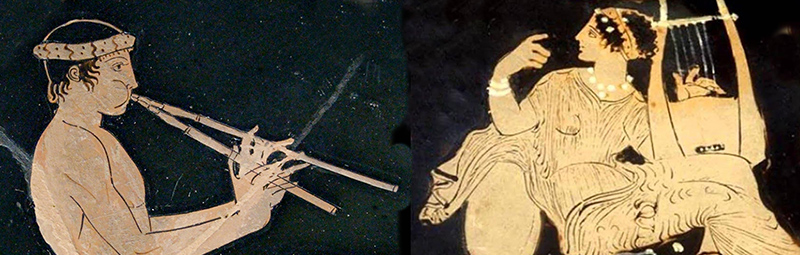
Melinda and Hugh will take us on a musical journey starting with the aulos, the lyre and the ancient Greeks but then rolling on though the ages. Stopping off briefly with Marin Marais and CPE Bach in the early 18th century, skipping nearly two hundred years to Debussy and Ravel and finally arriving at a new work for harp and oboe by Simon Holt.
To book, go here.
The aulos
The aulos, the first known oboe, was a double reed pipe played first in ancient Greece although in one guise or another it remained the principal wind instrument of most ancient Middle Eastern peoples. The pipes which were generally made of bone, wood, or reed were equal in length, held one in each hand and sounded simultaneously.
Oboist Melinda Maxwell has long been fascinated by the aulos and during COVID she started to study it in depth. There were, she says, ‘many designs and types of aulos that developed throughout its lifetime trajectory finishing at about the end of the Roman Empire. They played on many different occasions and in many different contexts; in paens (hymns of triumph and praise), dirges, and sacrifices, to marching to battle, in rowing, feasting, symposiums and dancing, and in private dinner parties’.
‘It is’, she continues, ‘a sophisticated instrument and one that requires a lot of time to understand how it functions; how to blow it, hold it (the finger stretch is unusual), how to make it play relatively in tune or otherwise, and most importantly what type of reed works best.’ But thanks to collaborations with other aulos enthusiasts she has not only managed to acquire a modern aulos but has learnt to play it. And she is going to play it for us.
If you would like to know more about the instrument, check in to the second half of this post on Melinda’s site. If you want to hear an aulos being played go here.
The lyre
The lyre, meanwhile, was the chosen instrument of Apollo, the Greek god of music and poetry – ‘the embodiment of harmony and artistic expression’.
(The story goes that the lyre was actually invented by Hermes who hollowed out the shell of a turtle to which he strapped the horns of one of Apollo’s sacred cows that he had nicked in a fit of boredom, and then used the cow’s guts for strings. But to pacify a somewhat peeved Apollo, he then had to give him the lyre.)
However lyres of all shapes and sizes, and made from a huge range of materials, were ubiquitous in all the cultures surrounding the Mediterranean, the oldest known examples dating back to 2700 BC.
Harpist Hugh Webb, like Melinda, has long been fascinated by the lyre – so this year he decided to buy himself one. Hugh’s lyre comes from Greece, is wooden (no turtles have been harmed) and has 7 gut strings. (It actually came with nylon strings but Hugh has replaced them with gut.)
Lyres are usually plucked like a harp but they can also be strummed with a wooden plectrum to create chords. Hugh says that one of the most difficult things about playing it is ‘adapting your ear’ to its tuning. While our sense of pitch and scales date from the 18th century, ancient Greeks would have had a whole different concept that can sound off kilter to our ears – not unlike Chinese or Indian classical music which adheres to different rules.
To hear the aulos and the lyre – not to mention Melinda’s oboe and Hugh’s harp in their more modern guise – book here.
And then… but first…
The Islington Festival has started
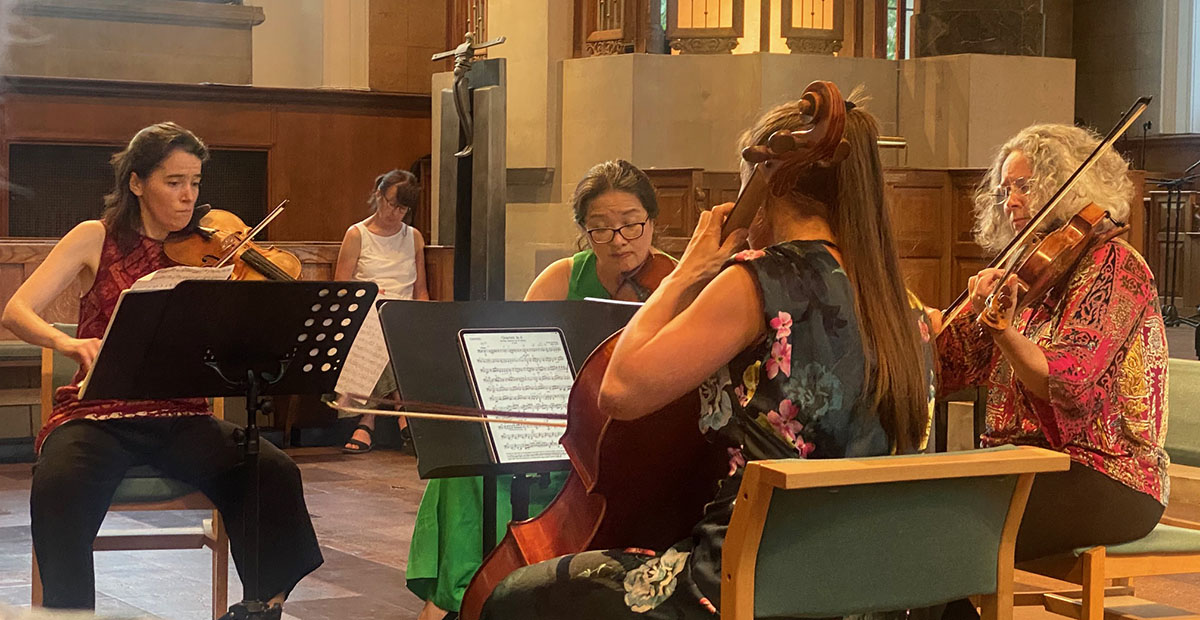 Here are Joanna Ly, Tamaki Higashi, Dorothea Vogel and Kirsten Jenson playing Franz Schubert’s Death & the Maiden at the opening concert on Friday night.
To see all the exciting events planned for this weekend and next, check in to their site here.
30th September – Good Evening Mr Sax – with Gerard McChrystal and William Godfree.
Gerard and William will present a history of the saxophone from its invention in the 1840s by the Belgian instrument maker Adolphe Sax. Featuring original music written for the saxophone in the 1850s and right through to William’s ‘Ballad in Blue’.
More details in a future post – or you can book up right now.
4th October – Highgate Society Sunday Lunchtime concert.
Jazz singer songwriter Immy Churchill will be performing classic songs from the ‘60s and ‘70s inspired by Joni Mitchell, June Tabor, Olivia Chaney and Nick Drake.
30th October – The guitar in the Salons of early 19th century Europe with Declan Hickey and Harmonicon.
More details to come very soon.
10th December – Nathaniel and La Pompadour invite you to their Christmas party!
Nathaniel Mander and his acclaimed spinet, La Pompadour, will be playing seasonal music from the court of Louis XVI – to be followed by a festive Christmas supper.
11th January 2027 – Madeleine Mitchell and the London Chamber Ensemble.
Madeleine and the Ensemble will be launching their final album of Charles Wood quartets – paired with some Beethoven.
Leave a Reply