Tuesday 27th October – last chance to book for Lucine Musaelian and Nathan Giorgetti – Viol da gamba and voice from 16th century Venice. Book here.
Healing
Those of you who are on the Sinfonia Smith Square’s mailing list may have noticed an alert for October 17th: Sanctuary: A Turning Leaf with the Purcell singers. This concert was the first of a new series created by the cellist Matthew Barley whose ‘dream has long been a concert, with the audience silently entering the hall with music already playing, and no applause between pieces. A place to sit together and take in the beauty of art…spacious… meditative…’
In an interesting article in The Strad (thank you Sheila Hayman for alerting me) Matthew sets out the thinking behind this series based on his desire to discover more about how the mystical healing power of music works. How can the way the audience enters the hall, what music is played, the applause, the silences, candles and incense and different combinations of performers including dancers – all affect the shared experience of musicians and audience? Can the mirror neurons in our brains that fire up when we do something physical, and when see someone else doing that thing, help to create a more active and transcendent relationship between players and listeners. How to amplify this connection to unite performers and audiences.
Keep an eye on the SSQ programme for the next concert in the series.
Feeling
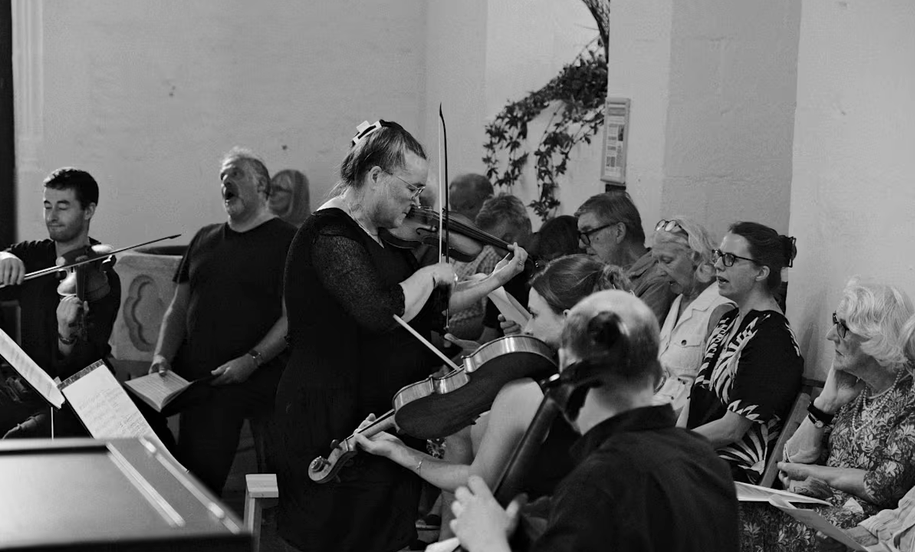
And I have to thank the Continuo Foundation, Bettina Varwig, Margaret Faultless and Nicholas Mulroy for the most fascinating article and documentary about their recent Bach St John Passion project.
Research into 16th and 17th century music making suggests that music was ‘widely experienced as a quasi material substance… which flowed out of musicians’ bodies and penetrated the bodies of those around them. Music could literally touch people inside and out; it could feel hard (dissonances) or soft (pleasant concords) on the skin; it could line your ears with honeyed sweetness or deliver a painful stab to your heart.’
Such physical reactions, although they can happen, are rare in modern music making in which the musicians play, in their space, and the audience listens, in its space. But Bettina, Margaret and Nicholas wanted to ‘recover some of the touching power of music.’ In a two day workshop, followed by two performances, performers wandered free, sat, knelt, danced stood back to back, made eye contact – allowing themselves to be ‘infiltrated and infected – physically touched – by the musical outflows of those around them’. The results for both musicians and audience were incredibly powerful.
To read Bettina’s article see the Continuo Connect site here and follow the link embedded in the article to the half hour documentary about the workshop.
I wonder if the current trend towards ‘immersive performances’ is in some way searching to re-create that closer physical link between audience and performer – see for example the Paraorchestra’s Virtuous Circle performance at the Festival hall that I saw last year.
Abolition Song and its Legacies (ASaiL)
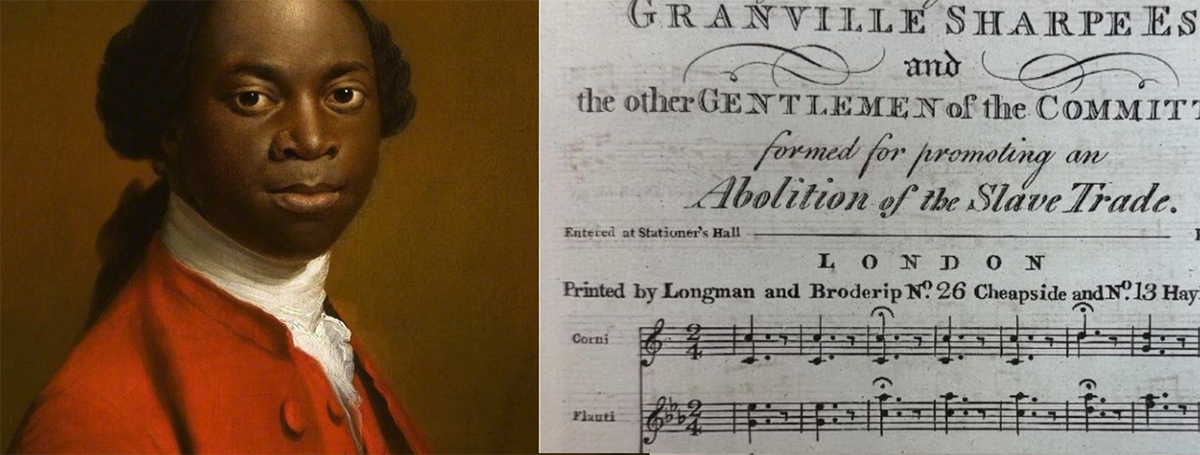
Last week found me at the Foundling Museum for the last in a series of Abolition Song concerts, a project created by Dr Berta Jancus at the GSMD ‘to explore the previously unknown repertory of British anti-slavery song (1787–c1830), the activist communities that generated it, and the perspectives and music of Black people of the time’.
Over a two year period ASaiL has been hosting scholarly morning seminars and evening concerts based around their research. ‘As the protest song of its day, Abolition song argued for recognising enslaved peoples’ inalienable human rights. It emerged in parallel with Black virtuosi performing in Britain, and against the backdrop of Black communities making music here since the 16th century.’
Giving us as taste of these songs were three harpsichordists and three singers – Daniel Lee Chappell, Nathaniel Mander and Yihan Zhao; Eleanor Rashid,Shafali Jalota and Alastair Sunderland. Songs were interspersed with readings from letters, several from Ignatius Sancho the black slave who was sent to Britain in the 1730s as a child, brought up in Greenwich and ‘adopted’ by the Duke of Montagu who taught him to read and write. With Montagu’s help Sancho was to become not only a successful shopkeeper selling goods such as such as tobacco, sugar and tea produced in the West Indies, but a successful writer and a leading light in the Abolitionist movement of the 18th century. (The image above may be of Sancho although that is disputed.)
The songs often made use of popular tunes to which words by poets such as William Cowper or Robert Burns were set or at least adapted:
It was in sweet Senegal that my foes did me enthrall,
For the lands of Virginia-ginia-O;
Torn from that lovely shore I must never see it more:
And alas! I am weary, weary O’
We also had keyboard solos from our three harpsichordists and ended by joining the singers in a ’round’ to a tune attributed to Handel:
Forc’d from home and all its pleasure
Afric’s coast I left forlorn
To increase a stranger’s treasure
Oer the raging billows borne.
Men indeed have bought and sold me
Paid our price in paltry gold,
But as theirs they have inroll’d us
Minds are never to be sold…….
Go here for more on the project and a video clip from an earlier concert in the Handel Hendrix House.
Campaign for the Arts petition

And finally…. A couple of days ago an email from Kadiatu Kanneh-Mason, the matriarch of the extraordinary Kenneh-Mason musical tribe, reminded me to support the Campaign for the Arts petition to Andy Burnham: ‘Include arts and culture as part of your ’10 year plan’. In fact I already had – but had been somewhat remiss in spreading the word.
Does he need to? He sure does…. To quote Kadiatu:
Last week the University of Nottingham confirmed that it is closing its Department of Music, axing 5 degree courses and silencing more than 100 years of music. This department pioneered how music is taught in this country; now it is gone.
I’m devastated by this news. This department helped make my family who we are. Konya and Jeneba had their first piano lessons with one of its professors; now they are touring internationally and playing with the Stuttgart Philharmonic Orchestra. As all my children grew up in Nottingham, the university gave them accompanists, teachers, places to perform, encouragement and expertise. Its closure is a colossal blow to the cultural life of the entire East Midlands and its impact will be deep and far-reaching.
The university blames “student demand”, but demand doesn’t fall by accident. It falls when arts subjects are squeezed out of schools, when arts GCSE and A-level entries then hit record lows, and when music is treated as a nice-to-have that’s easy to cut. Nottingham isn’t the first university to do this, and unless something changes, it won’t be the last.
Sign the petition here
Other up coming events
Sunday 29th November – Highgate Society Lunchtime concert.
Kassa Green-Jakcsi, saxophone, and Diarra Walcot-Ivanhoe, keyboard.
For more info and to book go here.
Thursday 10th December – Hampstead Lane
Nathaniel Mander and his spinet, La Pompadour’s Christmas party. Sold out.
Go here for more details and to join the waiting list.
Monday 11th January – Hampstead Lane
Madeleine Mitchell and her London Chamber Ensemble – Charles Wood and Beethoven quartets.
Go here for more details and to book.
Friday 26th February – Hampstead Lane
Miguel Angel Villeda Cerin plays Bach Cello Suite Number 5 and Kolday’s Sonata for Solo Cello.
Go here to book.
Leave a Reply