It is as well the sun has been shining so brightly for the last couple of weeks as both of my recent musical outings have been plunged in Stygian gloom.
The Rape of Lucretia was never a jolly tale. In essence, devoted wife Lucretia is so shamed by her ravishing by the Prince Tarquinious that despite the forgiveness of her loving husband, she takes her own life. And the HGO’s staging of Benjamin Britten’s chamber orchestra goes full on bleak: stark, industrial and almost entirely in black, dramatically lit from one side only – Lucretia’s white jacket and the pink suit of the female chorus being the only relief.
Based on the ancient Roman legend of the violation of Lucretia, Britten’s score, especially in the second act when the violation and the suicide take place, is searing. The 13 strong chamber orchestra, packed into a tiny space at the side of the Jackson’s Lane stage (how they do not all get their elbows tied up with each other’s instruments I have no idea) were superb; Britten’s crystal clear score allowing each instrument to perform almost as a soloist. Meanwhile, the cast were universally excellent. As is the plan with all HGO productions, I am sure we will see many of them in the future on larger stages.
For those used to Greek Choruses, the single figures of the male and female chorus who actually involve themselves in the action is interesting – although their attempt to give a Christian slant to the tragedy is slightly grating. The only other minor cavil was the lack of surtitles – an added expense which I suspect the HGO could not run to – maybe a sponsor out there? In a text heavy work with multiple characters singing together, I fear we may have missed quite a few of the subtleties of the libretto.
Sadly, yesterday’s was the last performance but anyone wishing to know more could still check in to the HGO’s excellent on line programme. Appropriately this includes a link to Solace – the largest domestic abuse and sexual violence charity in London.
And of course if you want to know more about the HGO and the inspiring work they do in launching and advancing the careers of young singers, check in to their website here. If you were up for supporting them you can find several ways to do so on their site here.
My other venture into the Stygian depths was to Stone Nest – the delightfully gloomy Victorian Gothic brick chapel tucked in behind Charing Cross Road and Shaftesbury Avenue – which does specialise in dark. On this occasion it was to see Figure and Alkanna Graeca in MOURN. And yes, it was very dark and all about mourning one’s dead.
Figure, under the leadership of artistic dirctor, Frederick Waxman have appeared several times in this blog before, and are all about historical performance; Alkanna Graeca are three Greek women, Dunja Botic, Alexandra Achillea and Irini Arabatzi, who are ‘blending raw folk traditions from the Balkans, Mediterranean, and Black Sea with free improvisation and expansive soundscapes’.
MOURN presents ‘a musical-theatrical experience of loss through the rituals of the Balkans and the music of 17th century Italy’.
Well, to be honest, it was so dark and mournful that that theatrical side of the performance was all but invisible – but the musical side was excellent: haunting, mysterious, ethereal, harrowing – and beautiful. Lully, Gesualdo, Monteverdi, Strozzi and Handel woven seamlessly through traditional laments from Georgia, Epirus, Thrace and Croatoslovenia. For a little further enlightenment and to quote from the programme:
In Renaissance Italy composers drew on Ancient Greek tragedy to invent a new declamatory style that sits between speech and song. The funeral laments that were woven into these dramas became central to early opera, and the style spread across Europe: the ‘lament bass’ – a repeating descending four note line – was used in Germany by Biber, in France by Lully and, nearly 1000 miles away, in England by Purcell in Dido’s lament.’
Sunday May 24th 12 noon – Emilija Karaliute
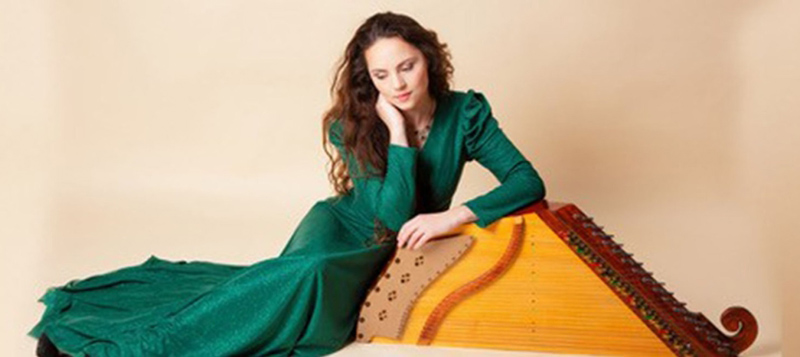
Nothing scheduled for Hampstead Lane in May while we take our short sabbatical – but on Sunday 24th at the Highgate Society (10 South Grove N6 6BS) Emilija Karaliute will be introducing us to her kanklés.
The kanklės is a Lithuanian plucked string instrument belongs to the Baltic box zither family. (Thank you Wikipedia.) According to Finnish linguist Eino Nieminen, the name of the instrument possibly comes from the proto-Baltic form *kantlīs/*kantlēs, which originally meant ‘the singing tree’.
The strings of a kanklés are parallel to the soundboard (not perpendicular, like in a harp) and do not extend beyond it (not like in, for example, a guitar, where they extend to the neck). Kanklės is usually rested on the player’s lap and played with the fingers or a pick made of bone or quill.
Wonder if the Lithuanian instrument is related time the Finnish kantele. It would seem though that the Finnish commentator would have mentioned it.
Hopefully all will be revealed on the day!!